
PGET 2027: what to study, and how to finish in the top 25%
The next PGET is expected in spring 2027. Here is where the 100 Paper I marks come from, the one block FCPS Part 1 does not cover, and a 12-week plan built around finishing in the top quarter.
On this page
UHS has opened a recount for PGET 2026. Here is how to apply, the likely fee and whether it can change your result.
The test is a race, not a pass mark
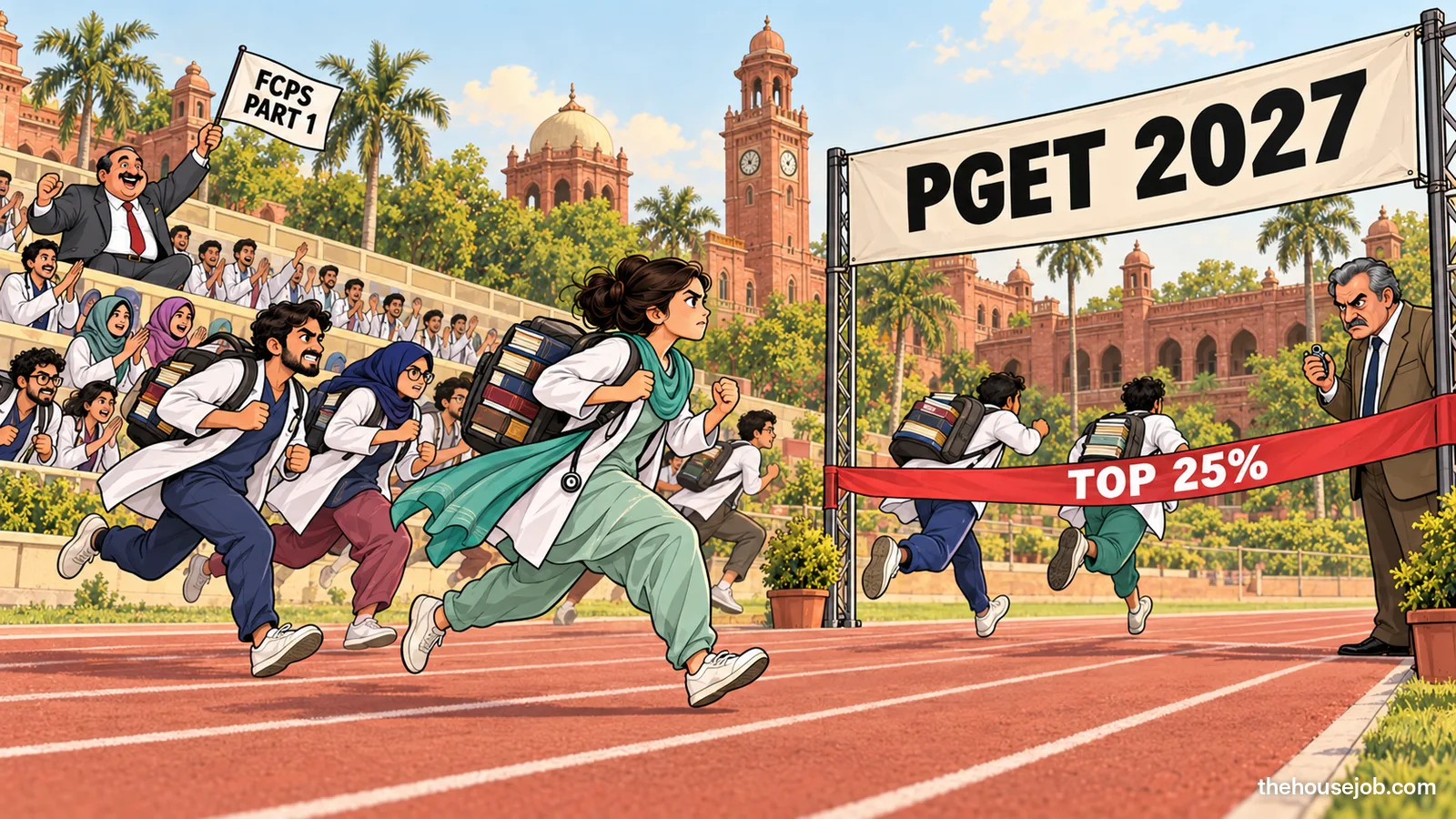
If you sat PGET in October, you already know the hardest lesson. It does not matter how well you do. It matters how well you do compared with everyone else in your specialty.
PGET passes the top quarter of each specialty track, at the 75th percentile. In October 2026, 2,131 of 8,271 candidates passed. If the paper is easy, the line simply moves up. We explain the rule in full in Why 3 in 4 doctors failed PGET.
So the question for 2027 is not "How do I pass?" It is "How do I finish ahead of three out of four people who studied the same books?"
When is the next PGET?
UHS plans to hold PGET twice a year, in March or April and again in September or October. The next sitting is expected in spring 2027. UHS has not announced the date, fee or registration window yet. Watch the UHS admissions website, and treat any date you see on social media as unofficial until UHS publishes it.
That gives most people somewhere between three and five months. The plan below is built for twelve weeks, so you can start it whenever the date is announced.
What the test looks like
| Part | What it tests | Questions | Time |
|---|---|---|---|
| Paper I | Basic medical sciences, same for every specialty | 100 | 2 hours |
| Paper II | Your chosen specialty only | 100 | 2 hours |
That is 72 seconds a question. Speed is not a bonus. On a test ranked by percentile, the doctors who finish the paper calmly beat the doctors who know slightly more but run out of time.
Where the Paper I marks come from
UHS published a table of specifications for Paper I. For MBBS candidates, the 100 questions split like this:
| Subject | Questions |
|---|---|
| Anatomy | 20 |
| Physiology | 19 |
| Pathology | 13 |
| Pharmacology | 13 |
| Community Medicine | 12 |
| Biochemistry | 11 |
| Microbiology | 7 |
| Behavioural Sciences | 5 |
Our PGET notes follow this table topic by topic: Anatomy, Physiology, Pathology, Pharmacology, Biochemistry, Microbiology, Community Medicine and Behavioural Sciences are organised exactly by the UHS syllabus, with exam-focus points and quick revision on every page.
| Total | 100 |
|---|
Three things stand out.
- Anatomy and Physiology are 39 marks. Nearly two in every five questions. If your time is short, this is where it goes first.
- Pathology and Pharmacology are another 26. Together with Anatomy and Physiology, that is 65% of the paper from four subjects.
- Community Medicine is 12 marks. More than Biochemistry, and almost twice Microbiology.
The one block FCPS Part 1 does not prepare you for
Candidates' recalls show the October 2026 Community Medicine questions were mostly biostatistics, research methods and ethics. See What PGET 2026 Paper I actually tested.
If you have studied for FCPS Part 1, you already have most of Paper I. Anatomy, Physiology, Pathology, Pharmacology, Biochemistry and Microbiology are the same ground.
Community Medicine is the gap. FCPS Part 1 tests biostatistics and research methods, but much of community medicine, such as epidemiology, disease screening, vaccination schedules, nutrition, environmental health and national health programmes, sits outside it. Twelve marks is too many to leave to luck when the line is drawn at a percentile.
Most FCPS candidates are within a few marks of each other on the basic sciences. Twelve community medicine questions can be the difference between the top quarter and the rest.
Paper II: your specialty
Paper II is entirely about the specialty you apply for: Medicine and Allied, Surgery and Allied, Obstetrics and Gynaecology, Paediatrics, Radiology, Anaesthesia, ENT, Ophthalmology and the rest. UHS has published a table of specifications for Paper II as well, a separate one for each specialty, listing the topics, subtopics and how many MCQs each block carries. It covers the MBBS curriculum for that specialty and its clinical application up to the end of house job. For example, cardiovascular medicine carries 14 MCQs in the Medicine and Allied paper, general surgery carries 55 in Surgery and Allied Group 1, and the Obstetrics and Gynaecology paper opens with 15 MCQs of applied anatomy, embryology and histology of the reproductive tract. Work through the table for your specialty and tick off its topics the way you would for Paper I.
If you studied FCPS Part 1 Paper 2 in your specialty, that is a strong base. The difference is that PGET ranks you against people applying for the same specialty, so the bar is set by your direct competition.
A 12-week plan
This plan assumes about three hours a day around work. Each block ends with a timed set, because a percentile test rewards speed under pressure as much as knowledge.
| Weeks | Focus | End-of-block check |
|---|---|---|
| 1 to 3 | Anatomy and Physiology (39 marks) | 60 timed questions, 72 seconds each |
| 4 to 5 | Pathology and Pharmacology (26 marks) | 60 timed questions |
| 6 | Community Medicine (12 marks) | 40 timed questions |
| 7 | Biochemistry, Microbiology, Behavioural Sciences (23 marks) | 50 timed questions |
| 8 to 10 | Paper II: your specialty | 100 timed questions |
| 11 | Full Paper I mock, then fix the weakest subject | Score by subject |
| 12 | Full two-paper mock on one day, then light revision | Both papers in exam timing |
Three rules make this work:
- Do questions every day from week 1. Reading without questions feels productive and is not. Aim for at least 40 a day.
- Review every wrong answer the same day. Read why the right answer is right and why your answer was wrong.
- No collapsing subject. The people just above the line are rarely brilliant at everything. They simply have no subject where they lose ten marks.
What to do this week
- Start with Anatomy and Physiology questions, not a textbook. Your score tells you what to read.
- Get a community medicine resource and read one topic a day alongside the plan.
- Keep your documents ready: PMDC registration, house job certificate and MBBS marks, so registration day is not a scramble.
- Note your October result. If you missed by a small margin, focus on speed. If you missed by more, focus on the 65 marks from the big four subjects.
Practise the big subjects now
Anatomy, Physiology, Pathology and Pharmacology make up 65 of the 100 Paper I marks, and they are exactly what our FCPS Part 1 question bank covers, with every option explained and timed mocks at 72 seconds a question. You can also start by subject from our MCQs by subject pages.
If you missed the earlier pieces, read Passed FCPS Part 1, failed PGET for what changed in Punjab's induction rules, and the 75th percentile trap for how the pass line works.
Sources: UHS PGET table of specifications for Paper I, as reported by Pakistan Era; UHS PGET admissions page; PGET 2026 results as reported by 24 News and Pakistan Observer (29 October 2026); Government of the Punjab, SHC&ME Department notification of 21 August 2026 (January 2027 induction). Paper format as described by UHS-focused preparation sites; check the official UHS advertisement for the 2027 sitting.
FAQ
When is PGET 2027? UHS plans to hold PGET twice a year, in March or April and in September or October. The spring 2027 date has not been announced yet. Check the UHS admissions website.
How many MCQs are in PGET? Two papers of 100 MCQs each, two hours per paper. Paper I is basic medical sciences and Paper II is specialty-specific.
Which subjects carry the most marks in PGET Paper I? Anatomy (20) and Physiology (19), followed by Pathology (13), Pharmacology (13), Community Medicine (12), Biochemistry (11), Microbiology (7) and Behavioural Sciences (5).
What score do I need to pass PGET? There is no fixed score. You pass if you finish at or above the 75th percentile of candidates in your specialty track, roughly the top quarter.
Is FCPS Part 1 preparation enough for PGET Paper I? It covers most of it. The main gap is community medicine, which carries 12 marks in Paper I and is largely outside the FCPS Part 1 syllabus.
How long should I prepare for PGET? Twelve focused weeks is a realistic plan if you already have FCPS Part 1 or recent MBBS knowledge. Start with questions in Anatomy and Physiology, which carry 39 of the 100 Paper I marks.
Try 5 FCPS Part 1 questions
Recall-based questions with every option explained. No sign-up needed.
Loading questions