
What PGET 2026 Paper I actually tested
We went through 100 recalled PGET 2026 Paper I questions subject by subject. The paper followed the UHS table of specifications to the question, the questions were one-step, and Community Medicine was mostly statistics, research and ethics.

On this page
The short answer
PGET 2026 Paper I did exactly what UHS said it would. When candidates' recalls are sorted by subject, they land on UHS's own table of specifications almost to the question. The questions were short and one-step. And Community Medicine, the subject everyone feared, was mostly statistics, research methods and ethics.
If you are preparing for the next PGET, expected in spring 2027, that is good news. The syllabus is published, the weighting is real, and the level is house-officer level.
UHS does not publish PGET papers. This analysis is based on about 100 questions recalled by candidates who sat Paper I on 25 October 2026 and shared online in two recall lists, one of them checked and refined by a candidate who sat the paper. Recalls are memory, not the paper itself: wording is approximate and some shared answers are wrong. We describe the topics in our own words and do not reproduce anyone's recall list.
The paper matched the blueprint
UHS published a table of specifications for Paper I before the test. This is the official split:
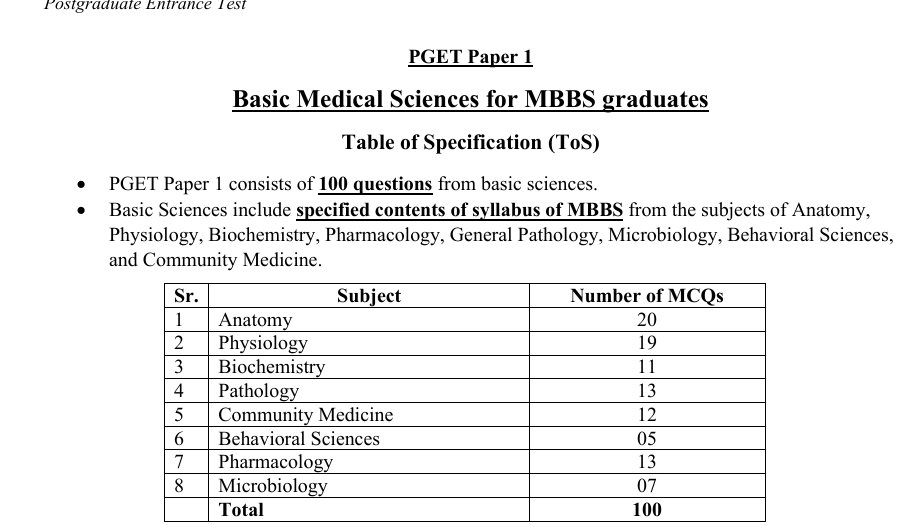
The fullest recall list, compiled by a candidate who sat the paper and sorted it by subject, has the same eight subjects with the same counts: 20, 19, 11, 13, 12, 5, 13 and 7.
So the first lesson is simple. Plan your time by those numbers. Anatomy and Physiology are 39 marks. Behavioural Sciences is 5. Spend your weeks accordingly.
What was asked, subject by subject
Anatomy (20)
Almost all applied. The favourite pattern was a fracture or an operation, then which nerve or vessel is at risk: shoulder fractures and the nerve that loses abduction, nerve damage after neck or prostate surgery, the vessel under the bicipital aponeurosis, the main blood supply of the femoral head, the order of structures at the renal hilum. Add a little embryology (the teratogen window in the first two weeks, sacrococcygeal teratoma), histology (collagen types, how osteocytes get nutrients) and neuroanatomy (cerebellar signs, dorsal column loss, the artery behind Broca's area).
Physiology (19)
Renal (what angiotensin II does to keep GFR up), the ECG (PR interval, normal axis), respiratory (V/Q extremes, high-altitude pulmonary oedema, why oxygen corrects some hypoxaemia and not others), a straightforward acid-base gas, endocrine (the LH surge, what inhibits prolactin, the stress response after surgery), haemostasis, upper motor neuron signs, hyperkalaemia and sleep.
Biochemistry (11)
Mutation types, single-gene inheritance risk, the HMP shunt in G6PD deficiency, telomerase, biotin and raw egg white, how ammonia travels to the liver, what happens when a type 1 diabetic misses insulin, the HIV enzyme that inserts DNA, protein synthesis and receptor types.
Pathology (13)
General pathology classics: types of necrosis, the point of no return in cell injury, exudate versus transudate, hypersensitivity types, ciliary dyskinesia and lymphoedema. Then a cluster on lung cancer paraneoplastic syndromes, plus bone metastases, a cholestatic enzyme and venous stasis after orthopaedic surgery.
Community Medicine (12)
This is the surprise. Almost none of it was environmental health or vaccination schedules. It was:
- Two quick calculations: a positive predictive value and a prevalence per 1,000.
- Statistics concepts: what p = 0.08 means, what a tiny sample does to power and type II error, which graph shows a continuous variable.
- Research methods: sampling methods, allocation concealment in a trial, loss to follow-up, herd immunity.
- Ethics and integrity: plagiarism and confidentiality.
- One occupational health question on ergonomics.
Behavioural Sciences (5)
Transference, non-verbal communication, cultural differences in how people report illness, coping styles and autonomy. All five are core topics in the UHS-recommended book, Mowadat Rana's Handbook of Behavioural Sciences.
Pharmacology (13)
Mechanisms and classic side effects: vancomycin, mesna with cyclophosphamide, metformin, ACE inhibitor cough, beta-blockers in heart failure, naltrexone versus naloxone, organophosphate poisoning and its two antidotes, efficacy versus potency, local anaesthetics, beta-lactamase, first-pass metabolism and a lithium interaction.
Microbiology (7)
One-line associations: the antiphagocytic factor of S. pyogenes, the biological indicator for dry heat sterilisation, the best test on day 3 of dengue, the virus behind Burkitt lymphoma, banana-shaped gametocytes, antibiotic-associated colitis and the roundworm with eosinophilia.
How hard was it?
Most questions were one step: recognise the classic picture, name the answer. A farmer with pinpoint pupils needs an antidote. A smoker with squamous lung cancer and high calcium needs a mediator. Very few needed two steps of reasoning.
That sounds easy, and candidates said it was. But PGET is not pass or fail on marks. You need to finish at or above the 75th percentile of your specialty. When the paper is easy, most people score well, the line moves up, and every careless mistake costs you places. We explain the rule in the 75th percentile trap.
Five lessons for PGET 2027
- Study from the table of specifications. It was followed. Use the subject weights to split your weeks, and the sub-topics as your checklist.
- Breadth beats depth. One-step questions reward knowing every classic association once, not one topic in great detail.
- Learn anatomy through injuries and operations. If you can say what a fracture or a surgical cut damages, you have most of the anatomy marks.
- For Community Medicine, master biostatistics, research methods and ethics first. The quick calculations (sensitivity, specificity, predictive values, rates) are free marks if you have practised them.
- Practise accuracy at speed. 100 questions in 2 hours is 72 seconds each. Timed practice is what stops easy marks slipping away.
Practise the big subjects now
Anatomy, Physiology, Pathology, Pharmacology and Biochemistry are 76 of the 100 Paper I marks, and they are the same ground as FCPS Part 1. Our FCPS Part 1 questions are pitched a little harder than PGET, which is the right direction to train in:
- Anatomy MCQs
- Physiology MCQs
- Pathology MCQs
- Pharmacology MCQs
- Biochemistry MCQs
- Biostatistics MCQs and Behavioural Sciences MCQs
Or open the full question bank and do one timed block of 20 a day. For the overall timetable, read our PGET 2027 plan.
Sources: UHS PGET Table of Specifications; UHS PGET admissions page; candidate recalls of PGET 2026 Paper I shared publicly after the 25 October 2026 test (two lists, one refined by a candidate who sat the paper). Topics are described in our own words. Last checked: 31 October 2026.
FAQ
Did PGET 2026 Paper I follow the table of specifications?
Yes. Candidates' recalls, sorted by subject, match the UHS split: Anatomy 20, Physiology 19, Biochemistry 11, Pathology 13, Community Medicine 12, Behavioural Sciences 5, Pharmacology 13, Microbiology 7.
Was PGET 2026 Paper I hard?
Candidates described it as easy and one-step. Because PGET is ranked by percentile, an easy paper raises the line, so careless mistakes matter more.
What came in Community Medicine in PGET 2026?
Mostly biostatistics, research methods and ethics: predictive value and prevalence calculations, p values, sample size and type II error, sampling methods, allocation concealment, plagiarism and confidentiality.
Does UHS release the PGET paper?
No. Everything known about the paper comes from candidates' recalls, which are approximate.
How should I prepare for PGET 2027 Paper I?
Split your time by the table of specifications, focus on classic one-step associations, learn anatomy through injuries and operations, and practise timed MCQs at 72 seconds each.
Try 5 FCPS Part 1 questions
Recall-based questions with every option explained. No sign-up needed.
Loading questions