
Why 3 in 4 doctors failed PGET: the 75th percentile trap, explained
What "75th percentile" really means, why your PGET result shows no marks, how the January 2027 merit formula is calculated, where FCPS Part 1 now stands, and what score you need next time.
On this page
UHS has opened a recount for PGET 2026. Here is how to apply, the likely fee and whether it can change your result.
The question everyone is typing
Since the UHS PGET result came out on 29 October 2026, the searches have been the same: PGET result, PGET passing marks, what is 75th percentile. Behind each one is a doctor trying to understand how a test she found manageable could say she failed.
This page answers those questions plainly. No jargon, no guesswork, and where something is not yet confirmed, we say so.
What "75th percentile" means
A percentile is a position, not a score.
If you are at the 75th percentile, you scored higher than 75% of the people in your group. To pass PGET, you had to be at or above that point in your own specialty track.
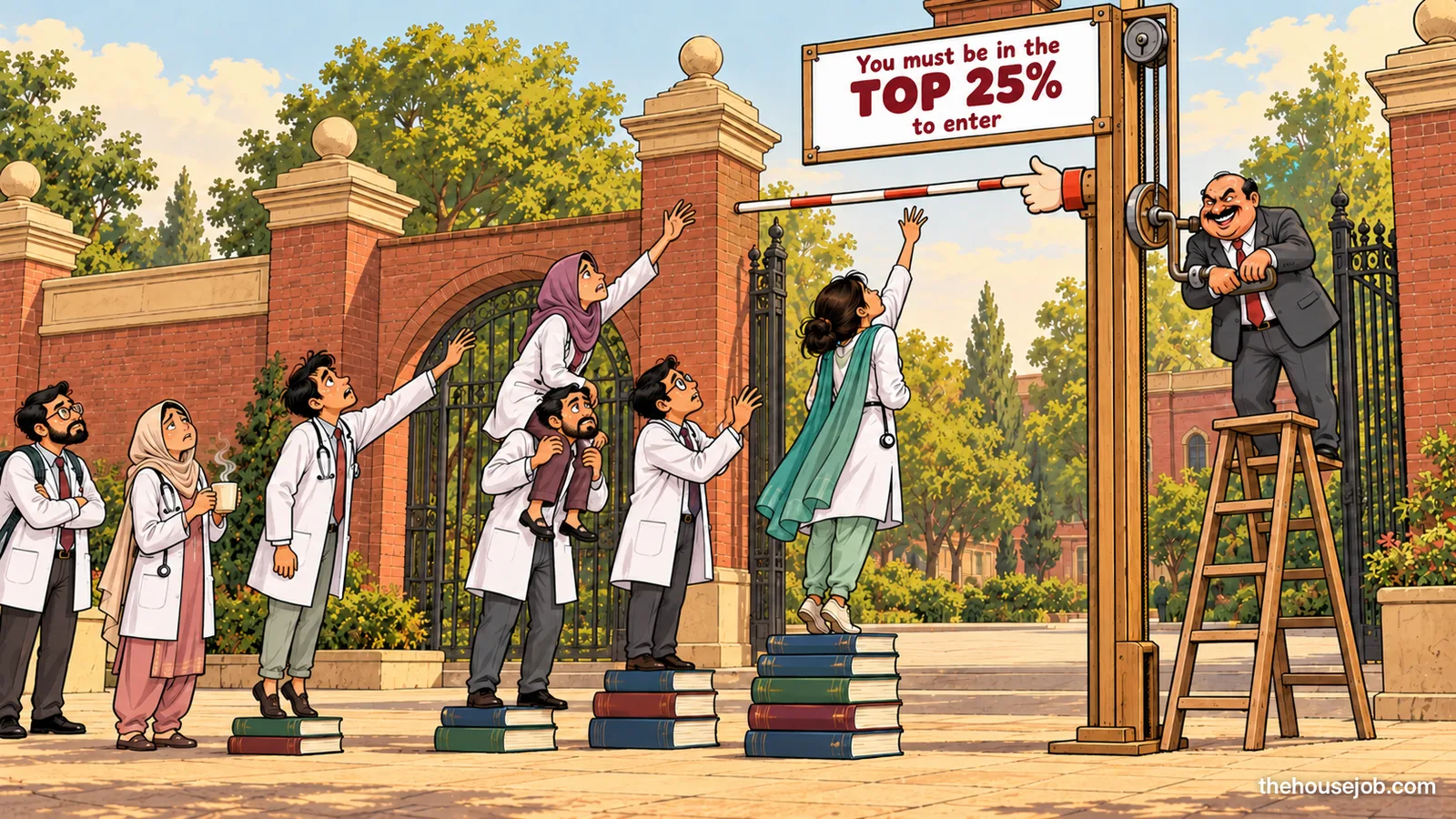
Think of it like this. Line up everyone who sat Medicine and Allied, from highest score to lowest. Count a quarter of the way down the line and draw a mark. Everyone above the mark passes. Everyone below fails. Where the mark falls in raw marks depends entirely on how everyone else did.
That is why:
- About 25% passed in every specialty. The rule guarantees it.
- A "fixed passing mark" does not exist. There is no 120 out of 200 or 150 out of 200 that guarantees a pass. If the paper is easy, the line moves up.
- Finding the paper easy does not mean you passed. If most people found it easy, the top quarter needed very high scores.
Pick your specialty
See how many sat, how many passed and how many people you had to beat. Source: UHS results, 29 October 2026.
Why your result shows no marks
The first result showed only Pass or Fail. No score, no percentile, no subject breakdown.
That matters, because a doctor who missed the line by two questions needs a very different plan from one who missed by thirty. Check the UHS admissions portal for any option to view your score or request a re-check, and keep the official notice. If marks are released later, we will update this page.
The new merit formula
Passing PGET does not give you a seat. It makes you eligible to compete for one. Seats are then allocated on merit under Punjab's Central Induction Policy (CIP).
For the January 2027 induction, the government notification No. SO(ME-I)7-7/2026(PRP-L-III)(JANUARY 2027), dated 21 August 2026, sets merit as 75% PGET plus 25% from a 25-point score:
| Component | Weight (%) | How it is earned |
|---|---|---|
| PGET | 75 | Your PGET score, converted to 75 marks |
| MBBS or BDS aggregate | 15 | Your total marks across all professional exams |
| University positions | 5 | First, second or third position in a university professional exam |
| House job | 5 | Depends on where you did your house job |
What changed from the old formula

Under the notification of 17 March 2026 (used for the July 2026 induction), merit was out of 30: MDCAT 2, MBBS aggregate 15, university positions 3, house job 5 and FCPS Part 1 or JCAT up to 5 (5 on the first attempt, 4 on the second, 3 on the third). A valid FCPS Part 1 or JCAT pass was also an entry requirement.
In the August 2026 formula above, FCPS Part 1 carries no marks.
In the August 2026 notification, FCPS Part 1 appears nowhere: not in the eligibility list, which now asks for a PGET pass instead, and not in the merit formula. MDCAT marks have gone too. CPSP still requires Part 1 before you can register for FCPS-II training.
We have taken both formulas from the government notifications themselves. Always check the Punjab residency portal for any later amendment before making decisions.
Where FCPS Part 1 fits now
It helps to see the two exams side by side.
| FCPS Part 1 | PGET |
|---|---|
| Set by CPSP, nationally | Set by UHS for the Punjab government |
| Decides if you can register for FCPS training | Decides if you can compete for a funded post in Punjab |
| Pass by meeting the standard | Pass by finishing in the top 25% of your track |
| Still required by CPSP for FCPS-II registration | Required for all Level-III induction in Punjab from January 2027 |
| Not mentioned in Punjab's January 2027 induction rules | Counts for 75% of merit |
So the honest answer to "what is the point of FCPS Part 1 now?" is this: in Punjab, it is your licence to compete. PGET is the competition.
What score do you need next time?
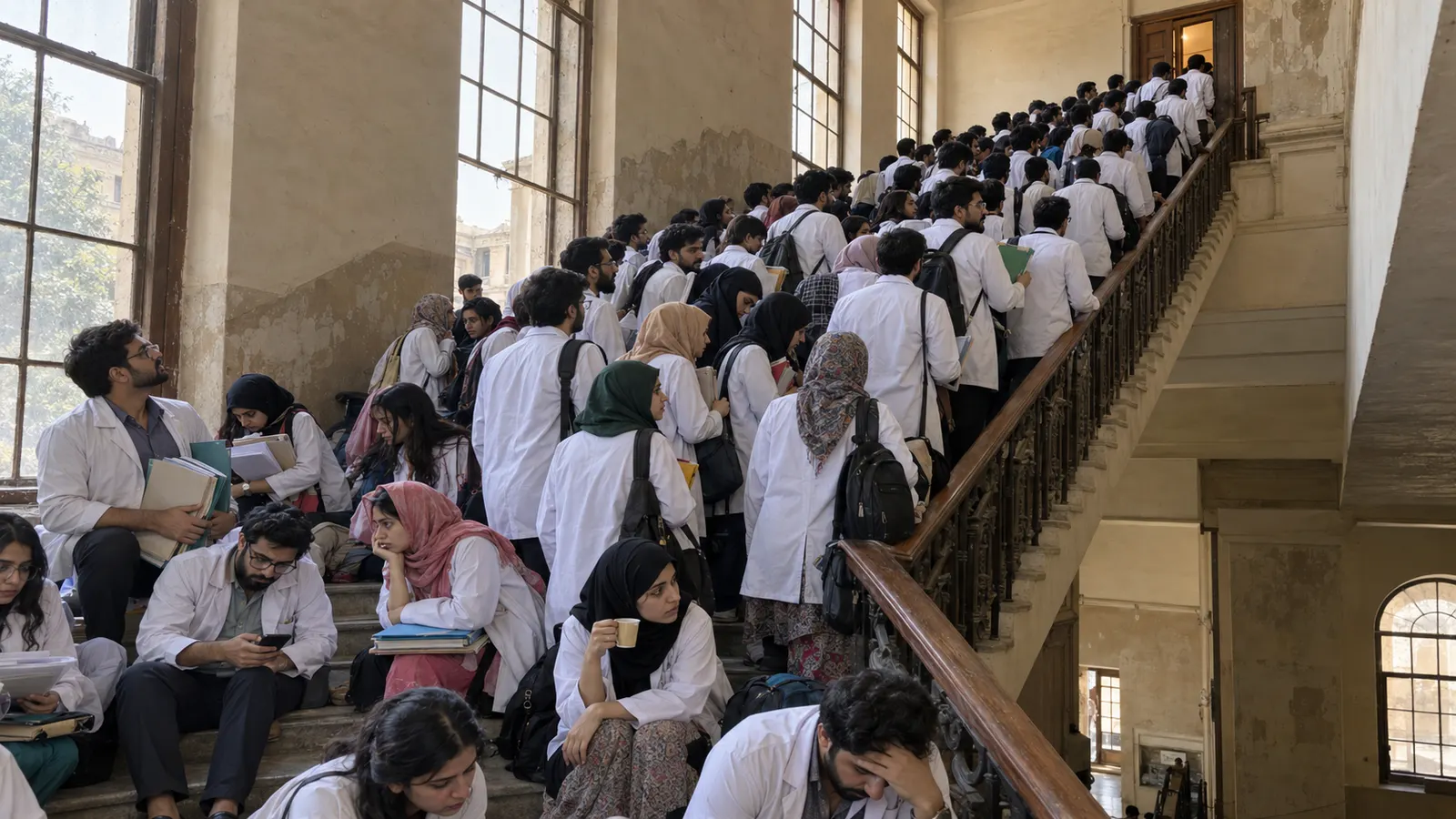
Nobody can give you a number, because the line depends on everyone else's performance on the day. Anyone selling you a guaranteed "safe score" is guessing.
What you can do is aim for the position. In practice that means:
- Be fast as well as accurate. Two papers of 100 MCQs each, two hours each. Time pressure decides percentiles.
- Know the high-yield basics cold. Paper I is basic sciences. The concepts that come up again and again in FCPS Part 1 are the same ones that separate the top quarter.
- Practise under exam conditions. Do full timed mocks, not just untimed revision.
- Fix your weak subject, not your favourite one. The candidates just above the line usually have no subject where they collapse.
The next PGET
UHS now plans to hold PGET twice a year, in March or April and in September or October. The next sitting is expected in spring 2027. Registration, fees and the exact date will be announced on the UHS admissions website. Do not rely on unofficial dates.
Prepare with what you already know
If you sat FCPS Part 1 recently, you are not starting from zero. You have already covered most of PGET Paper I. What you need now is sharpness: timed practice, fast recall and no weak subject.
Our FCPS Part 1 question bank covers the same basic sciences with every option explained, timed mock exams, and a knowledge tutor that tests the high-yield facts again and again until they stick. You can also practise by subject from our MCQs by subject pages.
For the story behind the result and the questions doctors are asking, read Passed FCPS Part 1, failed PGET.
Sources: UHS PGET admissions page; PGET 2026 results as reported by 24 News, Pakistan Observer and PGETexam (29 October 2026); Government of the Punjab, SHC&ME Department notifications dated 17 March 2026 (July 2026 induction) and 21 August 2026 (January 2027 induction); First Aid Made Easy on the exam format and fee.
FAQ
What is the passing mark of PGET? There is no fixed passing mark. You pass if you score at or above the 75th percentile of candidates in your specialty track, which is roughly the top 25%.
Why did about 25% pass in every specialty? Because the pass rule is a percentile. A 75th percentile cut-off passes roughly a quarter of each group by design.
Does FCPS Part 1 give marks in the new merit formula? No. The notification of 21 August 2026 does not mention FCPS Part 1 in either the eligibility list or the merit formula. CPSP still requires it to register for FCPS-II training.
Can I sit PGET without passing FCPS Part 1? Yes. PGET does not ask for FCPS Part 1. Without it you can still compete for MD and MS programmes.
Do I still need FCPS Part 1 for FCPS training? Yes. CPSP requires FCPS Part 1 before it registers your FCPS-II training, and in Punjab you now also need to pass PGET to get a training post. The January 2027 government rules do not mention Part 1 at all, and there is no official explanation of how the two fit together yet. This is our reading of the notifications; we will update this page when the government or CPSP clarifies.
How much is PGET worth in merit? 75 out of 100 marks. The rest are MBBS aggregate (15), university positions (5) and house job (5).
When is the next PGET? UHS expects to hold it twice a year. The next sitting is expected in spring 2027; check the UHS admissions website for the official date.
Try 5 FCPS Part 1 questions
Recall-based questions with every option explained. No sign-up needed.
Loading questions