
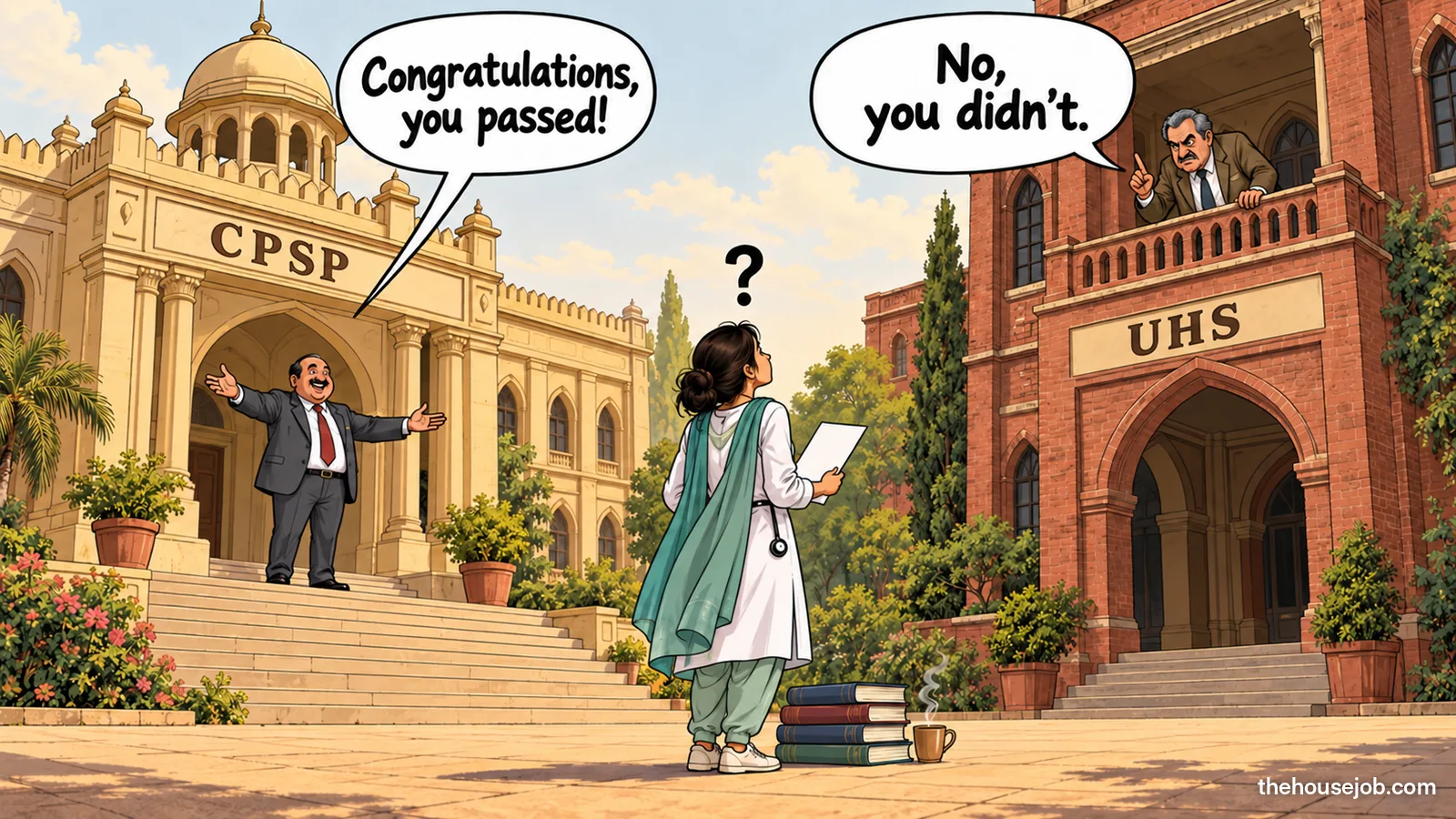
You passed FCPS Part 1. Punjab just decided it doesn't count.
Three in four doctors failed UHS PGET 2026, including doctors who had just passed FCPS Part 1. This is not a story about weak candidates. It is a story about a formula, and about the people it was always going to fail.
On this page
UHS has opened a recount for PGET 2026. Here is how to apply, the likely fee and whether it can change your result.
One word on a screen
Picture a doctor opening the result on her phone on the afternoon of 29 October, in the doctors' room between two admissions. There were no marks, no percentile, no breakdown. Just one word next to her roll number.
Fail.
Days earlier she had passed FCPS Part 1. Months of 5 a.m. alarms before a ward round, of recall PDFs on a cracked phone screen, of telling her family "after the exam" every time they asked her to come home. CPSP had looked at everything she knew and said: this doctor is ready to begin specialist training.
Then a second exam, set by a different body, on largely the same basic sciences, said she was not.
She is a composite, but she is not imaginary. She is hundreds of real doctors. On X that evening the same sentence kept appearing in different words. "FCPS passed candidates are failed in PGET." "Make it make sense." "I still don't understand the purpose of PGET when we are already giving the Part 1 exam."
If you are one of them, read this first: the result does not mean what it feels like it means.
What actually happened
The University of Health Sciences, Lahore, held the first Postgraduate Entrance Test (PGET) on 25 October 2026. About 9,000 doctors sat it across Lahore, Multan, Rawalpindi and Faisalabad. Results were announced on 29 October.
| What | Figure |
|---|---|
| Candidates in the result | 8,271 |
| Passed | 2,131 |
| Pass rate | 25.8% |
| Pass rule | 75th percentile within each specialty track |
| Marks shown in the result | None, only Pass or Fail |
PGET is now compulsory for every doctor who wants a Level-III training post in Punjab, which means FCPS-II, MS, MD and MDS, from the January 2027 induction. It replaced JCAT. If you do not pass it, you cannot be inducted this round, whatever else you have achieved.
Three in four were always going to fail
Here is the part nobody explained before the exam.
The pass mark was not a score. It was a position. To pass, you had to finish at or above the 75th percentile in your specialty track, which means in the top quarter of the people sitting next to you.
So before a single paper was marked, about three quarters of every specialty were going to fail. Not because three quarters were weak. Because that is what a 75th percentile rule does.

Look at the results by specialty and you can see the rule at work. Every single group landed in almost the same place:
Pick your specialty
See how many sat, how many passed and how many people you had to beat. Source: UHS results, 29 October 2026.
Real exams do not produce numbers this tidy. Formulas do.
If every specialty passes 25 to 28%, the exam did not find out who was good enough. It found out who was in the top quarter on one Sunday.
That is why some candidates came out saying the paper felt easy and still failed. When everyone finds a paper easy, the cut-off simply rises. You were not competing against the questions. You were competing against the room.
The formula that gave your Part 1 result zero marks
The 75th percentile is what made the result painful. The merit formula is what made it feel like a betrayal.
Until this year, Punjab's Central Induction Policy rewarded FCPS Part 1. The government notification of 17 March 2026, used for the July 2026 induction, listed a valid FCPS Part 1 (or JCAT) pass as an entry requirement and gave it up to 5 of 30 merit marks: 5 for passing on the first attempt, 4 on the second, 3 on the third.
Then came notification No. SO(ME-I)7-7/2026(PRP-L-III)(JANUARY 2027), dated 21 August 2026, issued by Punjab's Specialized Healthcare and Medical Education Department for the January 2027 induction onwards. Merit is now 75% PGET and 25% from everything else:
| Component | Weight (%) |
|---|---|
| PGET | 75 |
| MBBS aggregate | 15 |
| University positions | 5 |
| House job | 5 |
| FCPS Part 1 | Not mentioned |

Read the eligibility list in that notification and FCPS Part 1 is simply gone. Where the March notification said valid pass result of Part-I FCPS or JCAT, the August one says pass result of Post Graduate Entrance Test (PGET). CPSP still requires Part 1 before you can register for FCPS-II training. But in Punjab's own induction rules, the exam you spent a year on is no longer mentioned at all.
So a doctor can now spend a year passing CPSP's exam, and find that the year earns her nothing in the ranking that decides whether she trains.
So do you still need FCPS Part 1?
This is the question every one of us is asking, so here is our honest reading of it.
If you want FCPS training: you still need FCPS Part 1. CPSP will not register your FCPS-II training without it. And to get a training post in Punjab, you now also need to pass PGET. Two exams, one seat.
If you are aiming for MD or MS: you can sit PGET without FCPS Part 1, and the new rules only ask for a PGET pass. Part 1 is not part of that route.
What nobody has told us: the government's January 2027 rules do not mention FCPS Part 1 at all, and neither the health department nor CPSP has explained how the two fit together. What you have just read is our understanding from the notifications, not an official answer. We will update this page the moment either of them speaks. Until then, if FCPS is your goal, keep your Part 1 valid.
We are writing this as doctors who have been on the other side of that result screen. We have done the house jobs, the night shifts on no sleep, the years of studying with no idea what the rules will be by the time we are ready. Most of us have no job security, no clear path and no one to ask. Every year the policy changes. Every year a new test, a new formula, a new deadline. And every year it is young doctors who pay for it, in money, in time, and in years of hard work that suddenly count for nothing.
A system that cannot tell its doctors what they need to qualify, before they sit the exam, is not testing them. It is failing them.
All we are asking is to know the rules before the next induction. Is that really too much?
Why the anger is not just disappointment
Every exam produces people who are upset. This is different, and it is worth naming why.
Two exams, one door. FCPS Part 1 and PGET Paper I test largely the same basic sciences. Candidates prepared for one, paid for both, and now find the second overrides the first.
No marks, no explanation. A result that says only Pass or Fail gives a doctor nothing to learn from. You cannot tell whether you missed by one question or by forty. You cannot see whether your weak area was anatomy or pharmacology. You are told the outcome and nothing else.
The money question. The test fee was Rs 10,000. With roughly 8,300 to 9,000 candidates, that is around Rs 8 to 9 crore in fees for one sitting. Doctors are openly asking what that money paid for, and whether a test designed to fail three quarters of its candidates should cost each of them the same. That is a question, not an accusation, and it deserves a public answer.
The timing. FCPS Part 1 results came out in mid-October, days before PGET. Some doctors went from celebrating one result to failing the next within the same fortnight.
The case for PGET, fairly stated
It would be easy to stop there. But a piece that only tells you what you want to hear is not worth your time, so here is the strongest case for the test.
Punjab has far more eligible doctors than paid training posts. Every year, FCPS Part 1 passers pile up, and seats do not. Candidates for FCPS, MS, MD and MDS used to arrive with results from different bodies that could not be compared fairly. A single provincial test, sat on the same day by everyone, is at least the same ruler for all.
Seen that way, PGET does not decide who is competent. It decides who gets one of a limited number of funded posts. A doctor who failed PGET has not been declared unfit to train. She has been told she was not in the top quarter for this intake.
That is a real argument. But it has a cost, and doctors are entitled to ask whether the cost was explained, whether it was necessary to erase the marks for Part 1 entirely, and whether a result with no marks is acceptable for a test that decides careers.
Questions that still need answers
- Why was FCPS Part 1 removed from both the eligibility list and the merit formula, when CPSP still requires it for FCPS-II?
- Why are marks not shown? Will candidates be able to see their score and percentile?
- Where are the missing results? About 9,000 doctors sat the test; the result covers 8,271.
- How long does a PGET pass last, and will a doctor who passed this time need to sit it again?
- What is the re-check process, and how much does it cost?
If UHS or the health department answers any of these, we will update this page.
If you failed: read this before you do anything else
- Separate the result from yourself. A 75th percentile rule fails three quarters of any room, including rooms full of good doctors. You passed FCPS Part 1. That has not changed.
- Ask for your marks. Check the UHS admissions portal for a re-check or score request. Knowing whether you missed by two questions or twenty changes everything about your next plan.
- The next sitting is expected in spring 2027. PGET is now held twice a year. Confirm the date on the UHS website before you plan around it.
- Your Part 1 knowledge is your advantage. PGET Paper I is basic sciences, the same ground you have just covered. You are not starting again. You are re-sitting a ranking with most of the preparation already done.
- Practise under pressure, not just in theory. A percentile test rewards speed and accuracy on the day. Timed mocks matter more than another pass through the books.
You can keep your basic sciences sharp with our FCPS Part 1 question bank, which covers the same Paper I subjects, with every option explained, timed mock exams and spaced repetition that brings back what you get wrong.
A last word
Somewhere tonight a doctor is staring at the word Fail and wondering whether she was ever good enough. She was. CPSP said so only days ago.
What failed her was a design: a pass mark set by position, a merit formula that gave her hardest-won result no weight, and a result screen with nothing on it but one word.
Doctors can accept losing a fair contest. What they are asking for now is simpler than a seat. They are asking to be told the rules, shown their marks, and given a reason.
Sources: UHS PGET results as reported by 24 News, Pakistan Observer and PGETexam (29 October 2026); Express Tribune (26 October 2026); the UHS PGET admissions page; Government of the Punjab, SHC&ME Department notifications No. SO(ME-I)7-1/2026(CIS)(July 2026) dated 17 March 2026 and No. SO(ME-I)7-7/2026(PRP-L-III)(JANUARY 2027) dated 21 August 2026. Quotes are from public posts by doctors on X and are shown without names.
Try 5 FCPS Part 1 questions
Recall-based questions with every option explained. No sign-up needed.
Loading questions